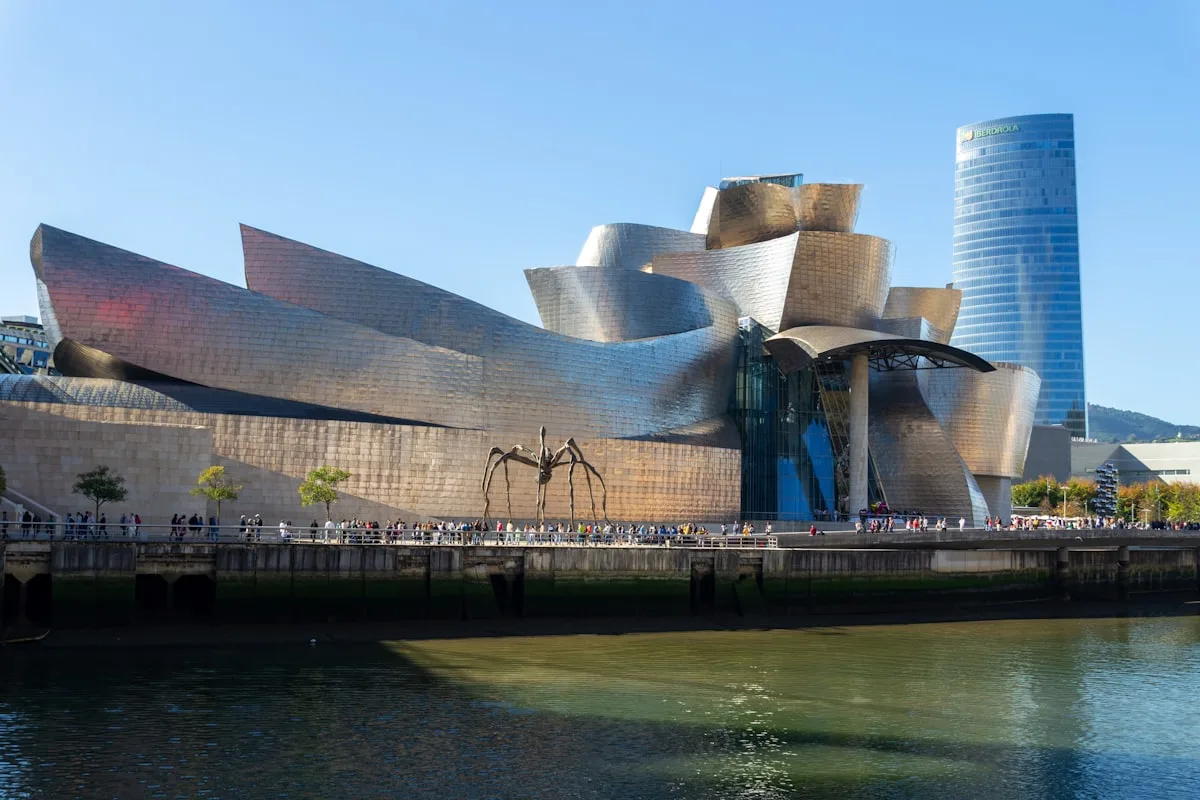
Frank Owen Gehry, born Frank Owen Goldberg in Toronto on February 28, 1929, died at his home in Santa Monica, California on Friday, December 5, 2025, at the age of 96, after what his chief of staff Meaghan Lloyd described to multiple outlets as a brief respiratory illness. His death was a public event in three time zones almost simultaneously: the Washington Post published two pieces within hours of the announcement — a formal obituary and, more interestingly, an architecture-critic appreciation by Philip Kennicott under the headline 'Frank Gehry made us care about architecture. Even if you hated his buildings.' The column has, in the five months since, become the most-cited single piece of writing in the legacy discussion — not because it captures every Gehry building, but because it captures the durable claim he has on architectural memory in a single sentence that the headline alone delivers.
Read again on May 11, 2026 — with the immediate flood of obituaries behind us, the Bilbao mayor's office now hosting visiting delegations on what is being called the Gehry-pilgrim circuit, and LVMH confirming through chairman Bernard Arnault that the Fondation Louis Vuitton in Paris has been planning a posthumous commemoration programme — Kennicott's framing of the legacy holds up better than most of the real-time commentary did. The five-month perspective lets us see what has settled, what has changed, and what the post-Gehry architectural conversation looks like now that the architect who, more than any other living figure, made the late-20th and early-21st-century icon-building possible is no longer the editorial reference point for that argument.
What Kennicott actually argued
Kennicott's thesis is doing two things at once. First, it concedes — up front — that liking Gehry's buildings is optional. The column's headline does not soften the central condition: "even if you hated his buildings." That concession is critical because it acknowledges the most consistent strain in the critical reception of his work since the 1980s, which is that the buildings are often spectacular without being legible, polarising without being deep, and (in the harsher version) decorative without being architectural in the discipline's traditional sense. Kennicott does not relitigate that argument. He sets it aside as conceded, and then makes his actual move.
Second, the move: that what Gehry did was force a generation of people — clients, mayors, museum directors, urban planners, and casual readers of culture sections — to care about architecture in a way the discipline had not been able to manufacture for itself for most of the postwar period. "Made us care" is not the same as "made us love." It is the broader and more interesting claim, because it survives the polarisation. Kennicott's framing in person matches the framing in the buildings: he describes Gehry — and this is the single most-quoted passage from the column — as "not oracular, or overbearing," a man who "didn't discourse on the history of architecture, even though he changed that history forever," who told self-deprecating stories, including a recurring joke about lobbying for a second Pritzker Prize because "it had been a long time since 1989."
Bilbao at 28 years: the only single-building metric that mattered
Any serious accounting of Gehry's legacy has to start with the Guggenheim Museum Bilbao, which opened in October 1997 on a brownfield site beside the Nervión river in Bilbao, Spain. Clad in a titanium skin developed in collaboration with Permasteelisa, set in limestone and glass, and modelled with 3D aerospace-grade software that Gehry's practice had adapted from the aviation industry, the building was instantly described by his American contemporary Philip Johnson as "the greatest building of our time" — a verdict that, twenty-eight years later, retains essentially that status in the single-most-influential-building-of-the-late-20th-century tier.
What Bilbao did to the city of Bilbao was the structural surprise. The titanium curves worked: tourism rose, hotel construction followed, restaurant and retail clusters formed around the Abandoibarra waterfront, and the regional economy that had been built around steel and shipbuilding rebranded itself, almost without coordinated planning, as a cultural-tourism destination. The pattern became known internationally as the "Bilbao effect," and within ten years it had been attempted — with varying success — by Abu Dhabi, Hong Kong, Dundee, Shenzhen, Singapore, Doha, Riyadh and dozens of mid-sized cities looking for a singular cultural building to do for them what Gehry's titanium had done for Bilbao. Most of those efforts under-delivered, because — as the BBC Radio 4 retrospective on the 20th anniversary put it — what worked at Bilbao was not just the building but the moment, the city, and the catchment it happened to sit inside.
Disney Hall and the criticism Gehry shrugged off
If Bilbao is the building everyone agrees on, the Walt Disney Concert Hall — opened in Los Angeles in October 2003 after a fifteen-year design-and-build process — is the building the critics split on. Clad in stainless-steel sheets that Gehry had described as "sails billowing in wind," it was greeted with one of the more memorable bursts of insult-prose in the discipline's recent history: "a pile of broken crockery," "a fortune cookie gone berserk," "an emptied waste basket." Gehry's reply, in a 2007 New Yorker interview that has been quoted in nearly every obituary since, was — "At least they're looking!" The line is funnier in his own delivery than on the page, but it is also a perfect thesis-statement for the Kennicott framing: attention itself is the durable win, and attention is the precondition for caring.
By 2026, the Walt Disney Concert Hall has settled into the Los Angeles civic identity in a way the 2003 critics did not predict — appearing in films, becoming a default backdrop for tourism marketing, hosting the LA Philharmonic through three decades of programming under Esa-Pekka Salonen and Gustavo Dudamel, and converting the "broken crockery" reading into the "Gehry sails" reading the city now uses on its own visitor maps. The reversal is the cleanest single case of Kennicott's "made us care" claim doing visible work over a long-enough timeline: criticism gave way to familiarity, familiarity gave way to identification, and the building stopped being a polemic and started being a landmark.
Where the style began: the 1978 Santa Monica house
Almost every obituary published in December 2025 noted that Gehry's breakthrough was not a museum or a concert hall, but his own house — a then-unremarkable bungalow in Santa Monica that he re-clad in 1978 using chain-link fence, plywood, corrugated steel and a tilted glass cube, and that the local neighbours regarded for the better part of a decade as an eyesore. The vocabulary it introduced — unfinished industrial materials, deliberately asymmetric assembly, visible construction-grade joinery, and a refusal to treat the existing structure as something to be erased rather than engaged with — became the underlying grammar of deconstructivism as the movement crystallised through the 1988 MoMA exhibition curated by Philip Johnson and Mark Wigley.
Trace that vocabulary forward and you can read it in almost every later Gehry project. The crumpled-paper logic of Bilbao, the University of Technology Sydney business school that locals nicknamed "the brown paper bag," the folded-glass tower of the Dancing House in Prague (completed in 1996 with co-architect Vlado Milunić), the bent-metal facades of the IAC Building in New York, the lattice-glass sails of the Fondation Louis Vuitton in Paris opened in 2014 — all of it is, in retrospect, the Santa Monica house's vocabulary running through forty years of progressively larger commissions. Paul Goldberger, whose 2015 authorised biography Building Art: The Life and Work of Frank Gehry remains the canonical reference, told BBC Radio 4's The World Tonight in his December tribute that Gehry "wanted to work until the day he died," and that he was "one of the very few architects of our time to engage people emotionally."
The catalogue: how widely Gehry actually built
The breadth of the built work is the part of the legacy that is easiest to underestimate if you anchor on the headline projects. Beyond Bilbao, Disney Hall, the Dancing House, the Fondation Louis Vuitton and the Gehry House, the catalogue includes the Vitra Design Museum in Weil am Rhein, Germany (1989) — his first European commission; the Weisman Art Museum in Minneapolis (1993); the Jay Pritzker Pavilion in Chicago's Millennium Park (2004) with its acoustic-trellis spanning the lawn; the MIT Stata Center in Cambridge, Massachusetts (2004) for computer science and AI; the Gehry Tower at Hannover; the Hotel Marqués de Riscal in Elciego, Spain (2006) with its waving multicoloured-titanium roofline; the 8 Spruce Street residential tower in New York City (2011), at the time the tallest residential building in the Western Hemisphere; the Luma Arles tower in France (2021); and a long string of museum, concert-hall, university and cultural-foundation projects across North America, Europe, Asia and Australia.
Underlying that breadth, technically, was an unusual organisational decision. Gehry's practice was one of the first large architecture firms to adopt aerospace-grade 3D modelling software — initially CATIA, developed by Dassault Systèmes for the Mirage fighter programme — and to use it to drive fabrication directly from the digital model. That choice did two things at once. It made his curved forms structurally and economically buildable in places they would not have been with conventional drafting, and it changed the vendor relationship: glass-and-metal fabricators in Europe, North America and Asia had to upgrade their own software stacks to take Gehry commissions, which set off a wave of digital-fabrication adoption that propagated through the rest of the discipline.
The starchitect era he made — and that survived him
Kennicott's column does not use the word "starchitect," but it is essentially about that argument. The post-Bilbao period — roughly 1998 through 2015 — is when the named-designer model of high-profile cultural and corporate commissioning became the global default: Zaha Hadid, Rem Koolhaas, Norman Foster, Renzo Piano, Jean Nouvel, Daniel Libeskind, Herzog & de Meuron, Santiago Calatrava, Tadao Ando, SANAA and a small handful of others were retained on the same logic as Gehry at Bilbao, because the building's authorship itself was the marketing. Hadid's death in 2016 was the first thinning of that generation, and Gehry's death in 2025 closes the founder-generation of the named-designer era in a way that practitioners under 50 are already explicitly framing as a handover.
What the starchitect model actually produced is a more open question now than it was during the building boom. The critique — that the cycle privileged spectacular singular commissions over patient neighbourhood-scale work, that it normalised astronomical fee structures, and that it served as a visible face for late-globalisation cultural-capital allocation — is one that Kennicott himself has worked through over more than two decades of Washington Post columns. His December read on Gehry specifically is generous within its bounds: he is willing to credit Gehry for the attention the era generated without signing off on the replication attempts that followed.
The tributes — and what they got right
The most-cited tributes from the December 2025 cycle were the ones that did not over-claim. Bernard Arnault, chairman of LVMH, said in a corporate statement on December 5 that Gehry "bestowed upon Paris and upon France his greatest masterpiece," a reference to the Fondation Louis Vuitton in the Bois de Boulogne — a defensible single-building call from the patron's perspective. Canadian Prime Minister Mark Carney issued condolences and a culture-specific line: "his unmistakable vision lives on in iconic buildings around the world." The Guggenheim Museum Bilbao posted: "We will be forever grateful. His spirit and legacy will always remain connected to Bilbao." And Paul Goldberger's BBC Radio 4 remarks — "one of the very few architects of our time to engage people emotionally … pushing the envelope, wanting to use the most advanced technology to do the most adventurous things" — is the line most likely to survive into the first edition of the longer histories.
Notably not in the tribute cycle: most of the obituary writers avoided the trillions tone that has crept into wealth-and-tech death notices over the last few years. Gehry's practice was a firm, not a fortune; his cultural footprint exceeded his financial footprint by orders of magnitude, and the tribute pieces let that asymmetry stand. The Simpsons appearance from 2005 — in which Gehry voiced himself designing a concert hall inspired by a scrunched-up letter, and which he later told The Observer in 2011 had "haunted" him because people genuinely believed his real designs came from crumpled paper — was the consistent comic note across the obituaries, and rightly so: it captured the unpretentious register that Kennicott put at the centre of his column.
Five months on, what the legacy is settling into
The single most useful observation Kennicott's column makes — read again on May 11, 2026 — is that making people care is a different metric from making people love. The five-month perspective makes that distinction durable in a way the same-day tributes could not yet evidence. Bilbao is still doing the work it has been doing for twenty-eight years. Disney Hall has crossed from polemic into landmark. The Fondation Louis Vuitton is now hosting the major Picasso/Bacon posthumous loan that LVMH had announced before Gehry's death. And the vocabulary he introduced in 1978 in Santa Monica — unfinished materials, legible construction, asymmetric assembly, the building as a legible artefact rather than an abstract compositional exercise — has migrated, in heavily diluted form, into the work of practitioners three generations younger than him.
The negative legacy is the one that is also clarifying. The replicability of the Bilbao effect turned out to be much lower than mid-2000s civic boosterism implied; the fee structures of the starchitect era have come under sustained pressure from clients who watched the cycle from outside; and the carbon cost of titanium-and-concrete cultural buildings is now an explicit constraint on the kinds of projects Gehry's successors can pitch. The 2026 architectural conversation is more sober than the 1997-2014 boom it inherits, and a meaningful part of that sobriety is precisely the recognition — which Kennicott's column threaded carefully — that Gehry's buildings were singular and that singular is not the same as a programme.
What remains, what is now permanent: the titanium curves on the Nervión river that everyone agrees on; the steel sails on Grand Avenue in Los Angeles that the city has converted from punchline into icon; the folded glass of Prague's Dancing House which has aged better than its 1996 critics expected; and the house in Santa Monica where the whole vocabulary started in 1978, and which is now — five months after its architect's death — a publicly-listed landmark on the Los Angeles historic register. Philip Kennicott's phrasing on December 5 turns out, on May 11, to be the most accurate sentence anyone wrote in the immediate hours after Frank Gehry died: he made us care about architecture. That is, by some distance, the more important thing for any architect to do than to make us love every building he ever signed.