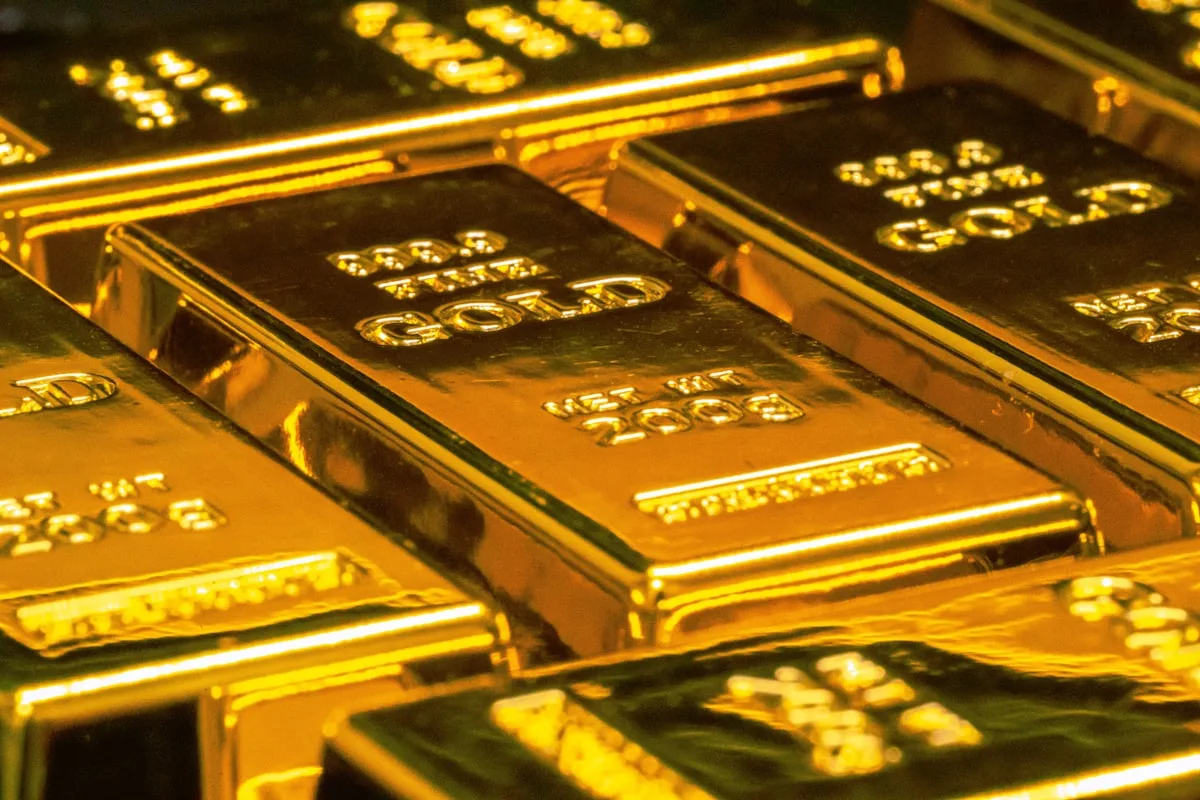
Gold opened the Monday, May 11, 2026 trading week lower and crude oil opened higher, in a clean commodities-market translation of one Truth Social post: President Donald Trump's Sunday-afternoon rejection of Iran's formal response to Washington's latest peace proposal as "totally unacceptable." Spot gold slipped 1% to $4,669.82 an ounce by 02:35 ET (06:35 GMT) on Investing.com data, with US Gold Futures down 1.1% to $4,678.31, unwinding the prior week's 2% rally that had been built on the opposite signal — hopes for an imminent end to the 10-week-old US-Iran war. Brent crude futures climbed $4.16, or 4.11%, to $105.45 a barrel at 0340 GMT in Singapore Reuters trade, and US West Texas Intermediate rose $4.38, or 4.59%, to $99.80 — both reversing the 6% weekly losses they had posted the prior week on the same peace-deal optimism that lifted gold.
The structural setup behind the gold-oil divergence is straightforward and worth stating plainly: when the market believes the US-Iran war is closer to a settlement, oil prices fall (less geopolitical risk premium, prospect of Hormuz reopening) and gold rises (lower inflation risk, lower-for-longer Federal Reserve rate-cut path, easier dollar). When the market believes the war is going to drag, the relationship reverses: oil rises on supply-disruption risk, the US dollar firms on safe-haven flows and on the implication that the Fed keeps rates elevated to fight oil-driven inflation, and gold falls because the non-yielding metal is squeezed between a firmer dollar (which makes gold more expensive for foreign holders) and a higher real-yield environment. Monday's move is the second pattern playing out in textbook fashion.
The headline trigger
Trump wrote on Truth Social on Sunday afternoon, May 10: "I have just read the response from Iran's so-called 'Representatives.' I don't like it — TOTALLY UNACCEPTABLE!" In a second post he accused Tehran of "playing games with the United States, and the rest of the World," adding that "for 47 years the Iranians have been 'tapping' us along." Iran's response, submitted via Pakistani mediators on Sunday, was a multi-page counter-proposal that, according to a Wall Street Journal report cited by Investing.com, "rejected U.S. demands to dismantle its nuclear facilities and would not suspend uranium enrichment for 20 years." The proposal did include, WSJ said, an offer to dilute some of Iran's highly enriched uranium and transfer the rest to a third country — but the headline takeaway in Monday trading was the no to dismantlement, and Trump's blunt Truth Social rebuttal.
The gold numbers, by the timestamp
Spot gold (XAU/USD) — $4,669.82 an ounce at 06:35 GMT, -1.0%. Investing.com's live tape showed the metal trading as low as $4,653.94 (-1.29%) intraday during the Asian session.
US Gold Futures (Comex) — $4,678.31 an ounce at the same timestamp, -1.1%.
COMEX gold, per Upstox's overnight reference at 9:52 p.m. ET on Sunday (just after Trump's Truth Social post), printed at $4,694.70 an ounce, -0.76% versus the prior $4,730 close — the first tape print of the new week, before the Asian open extended the loss.
Context: gold gained more than 2% the previous week as the market positioned for a US-Iran peace deal that would ease the geopolitical inflation premium. Monday's 1% decline reverses roughly half of that move in a single session.
The oil numbers, by the timestamp
Brent crude — $105.45 a barrel at 0340 GMT, +$4.16 / +4.11% (from $101.29 Friday close). Earlier prints from Investing.com's data feed via Upstox put Brent at $104.64 (+3.3%) at 07:22 a.m. IST, before the move extended through the Singapore open.
US WTI — $99.80 a barrel, +$4.38 / +4.59% (from $95.42 Friday close). The intraday spike took WTI above $99 for the first time in several sessions; Brent has not held above $105 in a sustained way since the early-April ceasefire window.
Last week's setup: both contracts had recorded 6% weekly losses on the peace-deal optimism track. Monday's gap-up effectively cancels the entire prior-week move and sets the Brent range back into the $103-to-$108 corridor that has held since the ceasefire took effect on April 8, 2026.
The dollar and the rate channel
The secondary channel through which the Iran rejection moved gold lower runs through the US dollar and through Federal Reserve rate expectations. The Bloomberg US Dollar Spot Index (DXY-style benchmark) was up +0.16% to 98.058 at the 9:52 p.m. ET Sunday print per Upstox, and Investing.com had the broader US Dollar Index 0.2% higher in Asian hours on Monday. Two things drove that: (a) the safe-haven bid as Iran-deal hopes faded, and (b) the carry-over from Friday's stronger-than-expected April nonfarm payrolls report, which prompted both Bank of America and Goldman Sachs to push back their Fed rate-cut timing later in the year (a trade carried by WTVB and other wires last week).
The combination — firmer dollar, higher implied Fed policy path, higher implied inflation from oil — is triple-negative for gold. The metal is non-yielding, denominated in dollars, and its rally in April and early May had been priced specifically against the alternative thesis (faster cuts, weaker dollar, lower oil). Monday's reversal is a reset of that thesis rather than a fundamental break.
Other commodities, for context
Silver — Mixed-signal Monday. Investing.com had spot silver up +0.2% to $80.51 an ounce in Asian hours; other wires reported silver down 0.7% in a different timestamp window. The volatility is consistent with silver's higher-beta behaviour relative to gold and is not a strong directional signal on its own.
Platinum — -1.4% to $2,030.04/oz on Investing.com's data — also caught in the gold-style firmer-dollar trade.
Copper (LME) — +0.3% to $13,608.33/ton; US Copper futures +0.4% to $6.32/lb. Copper is acting as the industrial-demand indicator rather than the geopolitical-risk indicator, and the modest move suggests that the Monday trade is being priced as a supply-side story rather than as a global-demand-destruction story.
The market commentary
"The oil market continues to trade like a geopolitical headline machine," said Priyanka Sachdeva, senior market analyst at Phillip Nova, in commentary carried by Nikkei Asia's Reuters wire, "with prices swinging sharply based on every comment, rejection, or warning coming from Washington and Tehran." IG market analyst Tony Sycamore wrote in a Monday client note that "market attention now shifts squarely to President Trump's visit to China this week. There is hope he can persuade Beijing to leverage its influence over Iran to push for a comprehensive ceasefire and a resolution to the ongoing disruption in the Strait of Hormuz." Trump is scheduled to arrive in Beijing on Wednesday, May 13, with Iran explicitly on the agenda alongside trade and global energy security.
Saudi Aramco CEO Amin Nasser said on Sunday that "the world has lost about 1 billion barrels of oil over the past two months" due to the war and the Hormuz closure, and that "energy markets will take time to stabilise even if flows resume." Kpler shipping-data flagged that two more tankers crossed the Strait of Hormuz last week with trackers switched off to avoid Iranian attacks — the supply that is getting through is doing so on terms that the official-flagged-tanker numbers do not fully capture.
ING analysts wrote in a Monday note that "even if the acute oil shock fades by late 2026, the ongoing risk of renewed disruption in the Strait of Hormuz, depleted inventories and weaker policy coordination is expected to keep a geopolitical risk premium embedded in prices." The bank expects Brent to remain above $90 per barrel through 2026 and to settle in a $80-to-$85 per barrel corridor into 2027 as demand growth resumes and global inventories are gradually rebuilt.
The Hormuz mechanics behind the price action
What the Monday tape is really tracking is the binary state of the Strait of Hormuz: closed (with CENTCOM enforcing a parallel US blockade) versus open. The 21-mile-wide waterway normally carries about 20% of the world's seaborne crude and about 25% of global LNG; with it largely shut for the past ten weeks, every percentage point of uncertainty over the duration of the closure shows up directly in Brent and WTI. Trump's Sunday rejection effectively pushed the expected duration of the closure out by some number of weeks, and the Monday open priced that.
Saudi Arabia and the UAE have been routing crude via the Red Sea ports of Yanbu and Fujairah respectively; Iraq has continued to load tankers from Basra under Iranian authorisation in selected cases (per a WANA wire item earlier on Monday); and Japan — as Newsorga noted in our parallel piece this morning — is taking its first Caspian-region crude cargo on Tuesday, May 12, from the Azeri-Chirag-Gunashli complex via the Baku-Tbilisi-Ceyhan pipeline. Each of those workarounds is real, but none replaces normal Hormuz throughput at scale.
What to watch
(1) The Trump-Xi meeting in Beijing beginning Wednesday, May 13 — whether Xi agrees to publicly lean on Tehran for a Hormuz settlement is the single most-important variable for the Brent range over the next two weeks.
(2) US CPI data due later in the week — a hot print combined with elevated oil would push the Fed rate-cut path further out, further damaging the gold setup.
(3) CENTCOM's posture on enforcement — any repeat of the Friday tanker disabling off the Gulf of Oman would lock in supply-disruption pricing on Brent; any easing of the US blockade would let some of the Iranian crude that has been sitting east of the strait reach the market.
(4) The BRICS Foreign Ministers' Meeting in New Delhi on May 14-15 — the only multilateral forum this week where Iran, the UAE, Saudi Arabia, Russia and India are in the same room. A chair's statement that goes further than last month's MENA SR language would shift the diplomatic baseline; a deadlock would reinforce the Monday trade.
(5) The Iranian counter-response to Trump's rejection — Tehran has so far framed the Truth Social post as narrative-building, but a formal statement from Foreign Minister Seyed Abbas Araghchi or President Masoud Pezeshkian beyond the Pezeshkian "never bow down" line could move the price in either direction depending on its operative content.
For now, the Monday open has answered the immediate question — the market is positioning for prolonged impasse rather than imminent settlement, gold has given back the prior week's peace-deal premium, and oil has reclaimed the upper end of the post-ceasefire range. The next print, like every print since February 28, will run through whatever Trump and Tehran say next.
Update — fresher intraday levels and new wires
Through the European session, the rally extended. Anadolu Agency clocked Brent at $105.55 a barrel at 9:26 a.m. local time (0626 GMT), +4.2% from the $101.29 Friday close, and WTI at $100.06, +4.9% from the $95.42 prior settlement — the first time WTI crossed the $100 handle since the early-April ceasefire took hold. NDTV Profit characterised the move as the resumption of the geopolitical-risk-premium trade that has gripped energy markets since late February.
Order-flow detail worth flagging: NDTV Profit reports that more than 4,000 lots of Brent's July contract changed hands in the first five minutes of trading — far above recent averages — and that Brent's prompt spread widened to nearly $4 a barrel in backwardation, a bullish curve structure that signals strong demand for immediate physical supply. Backwardation that deep at the front of the curve is the cleanest signal that traders are pricing prolonged Strait of Hormuz disruption rather than a soft, easily-traded headline reaction.
Netanyahu, drones and what the tape was really pricing
Two parallel signals reinforced the Monday bid. Israeli Prime Minister Benjamin Netanyahu told CBS News' Major Garrett, in an interview that aired Sunday, that the war with Iran is "not over" because "there's still nuclear material, enriched uranium, that has to be taken out of Iran" — a posture that, taken with Trump's Truth Social rebuttal, suggested coordinated Washington-Jerusalem reluctance to accept the Iranian counter-proposal as a starting point.
On the security side, NDTV Profit noted that a weekend drone strike briefly set a cargo vessel ablaze off the coast of Qatar, while the United Arab Emirates and Kuwait said they had intercepted hostile drones. None of those incidents was, on its own, a major supply event — but together they kept the insurance-premium component of the Brent price elevated through the open.
Iran's counter-proposal, in the words used Monday
Iran's state broadcaster Press TV reported early Monday that Tehran's 14-point counter-proposal calls for compensation from the United States, full Iranian sovereignty over the Strait of Hormuz, an end to sanctions and the release of frozen Iranian assets. Press TV said Tehran rejected the US plan because it would have required submission to "excessive demands." Separately, Iran's foreign ministry described its own response as "generous, responsible," according to Anadolu Agency — a framing Foreign Ministry spokesperson Esmaeil Baghaei also pressed at his Monday weekly briefing.
The supply-side ceiling: IEA, Aramco and Goldman
Three further pieces of analyst commentary, all published or recirculated Monday, anchored the bullish-supply case:
International Energy Agency: described the Iran war as "one of the most severe supply shocks ever faced by global oil markets," per the NDTV Profit summary — language stronger than the IEA used during either the 2022 Ukraine or the 1990 Gulf invasions.
Saudi Aramco CEO Amin Nasser: extended his earlier 1-billion-barrel loss estimate by warning that oil markets "may not fully normalise until 2027" if shipping constraints persist for several more weeks. The implication — that even a successful peace deal would leave the supply chain in catch-up mode for a year-plus — is one of the strongest fundamental anchors for the ING "above $90 through 2026, $80-$85 into 2027" forecast quoted earlier in this piece.
Goldman Sachs: a Goldman survey of institutional respondents found most expecting Hormuz disruption to continue well into the second half of 2026, per NDTV Profit — a baseline that is bearish for refined-product availability and bullish for the front of the Brent curve.
The Modi backdrop and the rupee-importing economies
Newsorga's parallel piece this morning on Indian Prime Minister Narendra Modi's Sunday Secunderabad address — in which he asked Indians to use less fuel, revive work-from-home, postpone foreign travel and gold purchases for a year — reads, in light of Monday's oil tape, as an early demand-side policy lever from the world's third-largest crude importer rather than just political rhetoric. NDTV Profit linked the two stories together explicitly under the headline framing "Modi Revives Covid Playbook — Work From Home, Carpool, Cut Travel — As Crude Surges," and the Indian EV complex (Ather Energy, Ola Electric, JBM Auto) rallied up to 8% in Mumbai trade on the back of the PM's appeal.
The structural point: with Brent at $105 and WTI at $100, every major net oil-importing economy in Asia — India, Japan, South Korea, Thailand, the Philippines — is now running fiscal-and-current-account math that did not work at the post-ceasefire $95-$100 range that prevailed last week, and the longer Brent holds the new range the more demand-side policy responses like Modi's should be expected from elsewhere.
The bottom line on the Monday oil rally
Stripped to its essentials: a single Sunday afternoon Truth Social post rolled back the 6% weekly decline both contracts had posted on peace-deal optimism, drove Brent through $105 and WTI briefly through $100, widened the Brent front-month backwardation to roughly $4, and put a fresh floor under the geopolitical-risk premium that Aramco, the IEA, Goldman Sachs and ING are now openly modelling as a multi-quarter feature rather than an event-driven spike. The next two market-moving events on the calendar are President Trump's Wednesday, May 13 arrival in Beijing for talks with Xi Jinping and the May 14-15 BRICS Foreign Ministers' Meeting in New Delhi — and the Monday tape is the market pricing the prior on each.