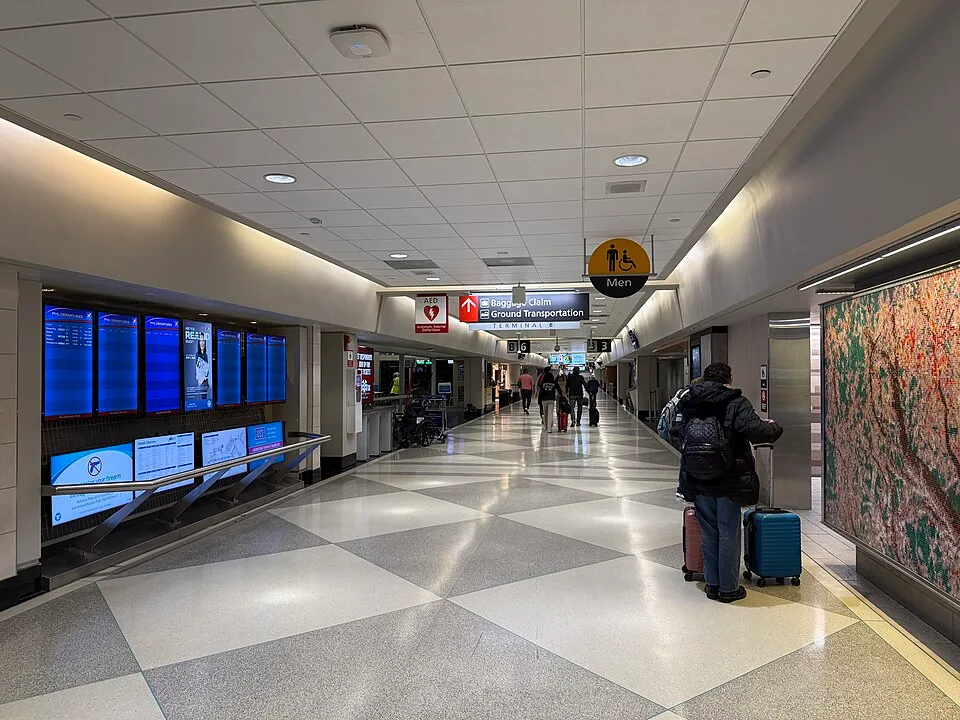
U.S. Customs and Border Protection (CBP) says officers at Philadelphia International Airport (PHL) seized $44,690 in unreported currency from a traveler boarding a flight to Cancún, Mexico, on Thursday, April 30, 2026, after a currency detector dog named Nitro alerted during outbound screening (confirmed in CBP’s local media release). The agency described the traveler as a 54-year-old naturalized U.S. citizen from Peru and said he was released after officers returned $240 “for humanitarian purposes.”
What officials say happened at the gate
According to CBP’s account, officers were conducting outbound enforcement when K9 Nitro, described as a three-year-old male chocolate Labrador retriever trained to detect bulk currency, firearms, and ammunition, alerted on the man. Officers said they advised him of federal currency-reporting rules and asked how much money he was carrying. The traveler declared verbally and in writing that he possessed $10,000—the threshold at which additional reporting kicks in (reported).
During a follow-on inspection, officers reported finding cash in his pockets, in separate envelopes, and inside his carry-on bag, with the combined total reaching $44,690. CBP said it seized all currency because of a violation of federal currency reporting laws—language that, in administrative cases, typically points to a reporting or structuring issue rather than a final court determination of guilt (reported).
The $10,000 rule travelers often misunderstand
Federal rules do not cap how much currency a person may carry internationally; the core requirement is disclosure. CBP states that amounts over $10,000 generally must be reported to the U.S. Treasury using the FinCEN 105 form (Report of International Transportation of Currency or Monetary Instruments). The agency has promoted an online submission path at fincen105.cbp.dhs.gov and notes travelers can also ask CBP officers at the departure gate for help completing the paperwork (reported).
Local television coverage summarized the episode as a reminder that any amount above the threshold must be reported—not only neatly bundled bank bricks—and that detector dogs are used precisely because cash can be split across bags and clothing (reported).
Agency messaging and possible downstream consequences
In the CBP release, Acting Area Port Director Elliott Ortiz is quoted saying: “This traveler concealed currency in multiple locations for the purpose of evading federal currency reporting laws, but no amount of concealment can hide bulk currency from Customs and Border Protection officers and especially from CBP canine Nitro.” The same statement warns that beyond seizure, travelers can risk missing flights and potential criminal prosecution tied to bulk currency smuggling allegations when facts support it (reported).
CBP also cites a fiscal-year enforcement statistic—about $180,000 per day in unreported or illicit currency seized agency-wide in FY 2025—to frame airport stops as part of a much larger portfolio of border and port-of-entry work (reported).
FinCEN 105 and what actually counts toward the threshold
The FinCEN 105 (CMIR) obligation is not limited to crisp $100 bricks. Monetary instruments can include certain travelers cheques, money orders, and negotiable bearer paper when the aggregate carried or shipped crosses $10,000—so splitting $6,000 between a jacket and a roller bag does not reset the math if another $5,000 sits in a wallet. Mixed-currency stacks add another wrinkle: travelers must convert MXN, EUR, or other notes to USD equivalents at a Treasury-consistent rate before deciding whether they are under the line.
CBP promotes online filing at fincen105.cbp.dhs.gov, but last-minute gate submissions still depend on officer bandwidth to validate bands, serial ranges, and provenance notes. People moving lawful proceeds from a home sale or small-business float sometimes wire the funds instead; a modest wire fee can buy more schedule certainty than a multi-hour secondary and a seized carry-on.
Civil forfeiture, petitions, and timing reality
Administrative seizure starts a paper trail that may branch toward civil forfeiture in federal court or toward remission/petition tracks if the traveler can document legitimate sourcing. The CBP release does not adjudicate those merits—it records probable cause for the border stop. Published case surveys (not this traveler’s file) often describe 90- to 180-day windows for uncontested civil releases when counsel files early and bank CTR records exist; contested matters can run longer.
The agency’s decision to return $240 for humanitarian purposes matches a recurring public-affairs pattern: leave a stranded passenger with meal and ground-transport cash while the bulk of counted notes moves into evidence custody pending Treasury and U.S. Attorney review (reported as CBP narrative).
What readers should take away
This file is not a substitute for legal advice: administrative seizure cases can later involve petitions for remission, forfeiture proceedings, or criminal referrals depending on what investigators conclude. For ordinary travelers, the practical headline is simpler: if you are near or above $10,000 in cash or covered monetary instruments leaving or entering the United States, stop and complete the Treasury reporting step before assumptions about “declaring $10,000” turn into a missed flight and an empty wallet at the x-ray belt.