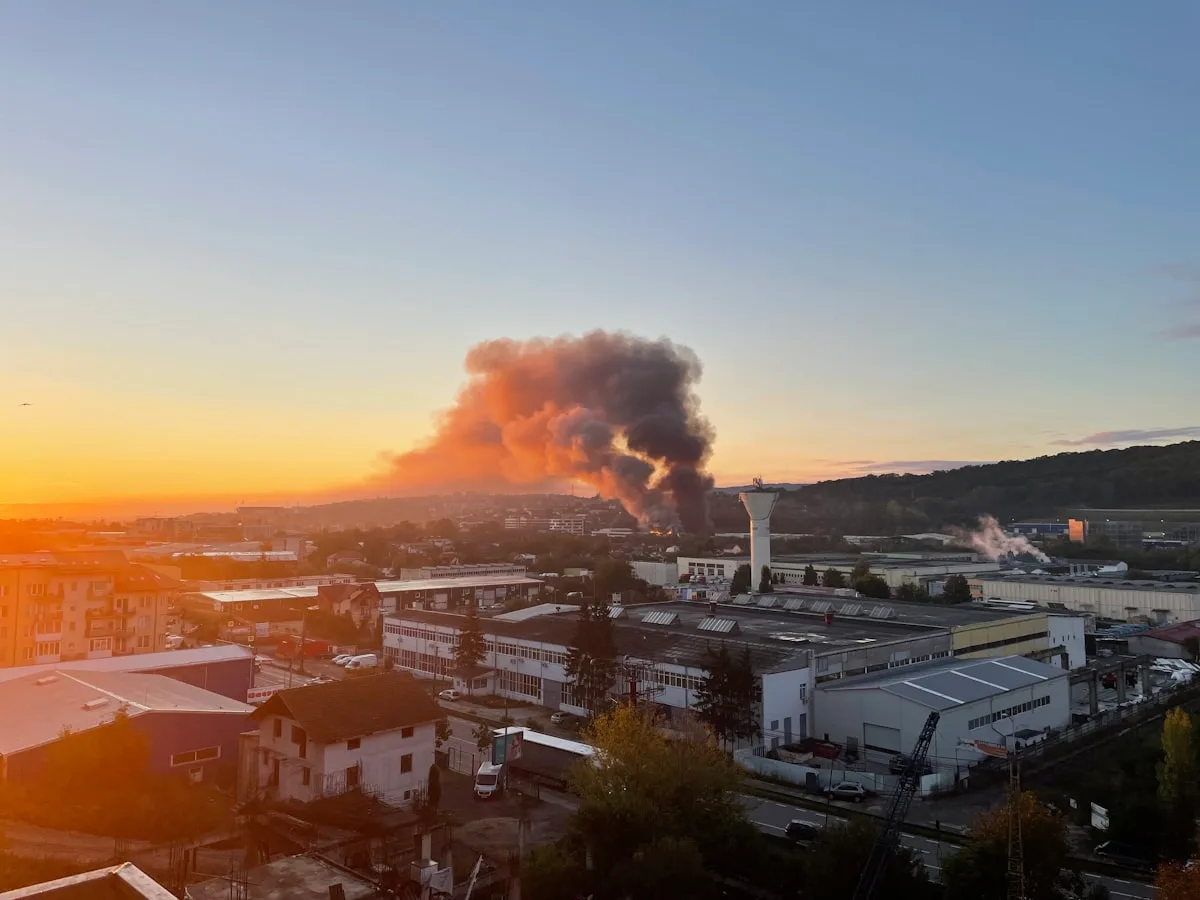
A two-alarm fire that broke out just before noon on Friday, May 8, 2026 at Sigma Renew 360, Inc., the plastic polyethylene-pellet plant at 170 Mark I Drive in Henry, Tennessee, burned for more than 24 hours and destroyed all three buildings on the site, the Henry County Emergency Management Agency said in a Saturday-morning update. Every one of the eight employees on shift at the fully staffed plant was evacuated, and no injuries or fatalities have been reported, the EMA director told local broadcasters as the smoke plume reached its peak.
By Saturday morning, after firefighters from more than 20 out-of-county agencies worked through the night, the Henry County EMA announced on its Facebook page that the Sigma fire is close to being fully extinguished. Crews from the Tennessee Air National Guard, multiple state agencies, EMS, the 911 centre and surrounding county EMAs assisted under mutual aid; the site has since been handed over to an environmental cleanup contractor that is on the ground beginning work to control water runoff from the firefighting effort. The cause of the blaze remains under investigation by the Tennessee state fire investigator and no preliminary findings have been released as of Sunday afternoon.
Friday, just before noon: how the fire began
The large structure fire was reported just before noon on May 8 at the 170 Mark I Drive address in Henry, the small town in Henry County in northwestern Tennessee, roughly two hours west of Nashville and 25 minutes east of the Tennessee River. The first alarm went out to the Henry County Fire Department and immediately escalated to a two-alarm response as flames spread across the three buildings on the Sigma Renew 360 compound. The McKenzie Fire Department, the Carroll County Fire Department, the Madison County Fire Department, the Milan Fire Department and the Dresden Fire Department were among the first mutual-aid units on scene, with additional agencies joining over the following hours.
Within the first ninety minutes, the entire compound was visibly involved. Sigma Renew 360 manufactures polyethylene pellets — the small plastic-resin beads that feed downstream extrusion and bag-making plants — and the loose pellet stock, packaging cardboard and plastic-film inventory typically held inside such a facility provide a uniquely uniform fuel load: low ignition threshold, high flame spread once started, and a smoke output dominated by soot, hydrocarbons and combustion byproducts that produced the characteristic giant black plume captured on aerial video and shared widely on Friday afternoon.
Through the night: 20-plus agencies and Saturday extinguishment
Mutual-aid response scaled rapidly through Friday afternoon and evening. By the time the Madison County Fire Department issued its update describing crews who 'worked tirelessly alongside multiple agencies to bring this incident under control,' the operation had grown to include departments from across West Tennessee — the EMA count of more than 20 out-of-county agencies is consistent with the public mutual-aid logs the surrounding counties have shared. The Tennessee Air National Guard provided aerial support and equipment; state agencies coordinated highway closures and traffic diversion; EMS held in standby at the perimeter; county EMAs managed responder accountability.
The fire burned through Friday night, with crews rotating in shifts under high-volume water deployment. The Henry County EMA's Saturday-morning Facebook update described it as 'a long night' and singled out 'the wonderful persons manning the rehab center' — the firefighter rest-and-rehydration station maintained on-site — along with Tosh Farms and Norwood Farms, two local agricultural operations that supplied donated food, water and equipment to the responders. The blaze was reported to be close to fully extinguished by mid-morning Saturday, more than 24 hours after the initial alarm.
Why the human toll is zero: 8 employees evacuated on Friday
The single most consequential fact in the Henry County EMA's running statement is that the plant 'was fully staffed and operational' on Friday morning when the fire began — yet no injuries were reported in any of the official local-news updates posted through Saturday afternoon. The detailed local-broadcast counts identify eight employees as having been on shift at the moment of ignition, and all eight were accounted for and evacuated through the plant's own egress route before the first arriving fire trucks reached the compound.
The zero-casualty outcome is unusual for an industrial fire of this magnitude. OSHA and NFPA counts of US polyethylene-pellet plant fires over the past decade typically include one or more burn injuries among employees who attempt early extinguishment before mutual-aid arrives; the Sigma Renew 360 evacuation pattern, in which all on-shift staff cleared the buildings without attempting to fight the fire themselves, is the textbook OSHA-recommended response and is the simplest explanation for why three buildings became a total loss while every employee walked out unhurt. Henry County officials credited the plant's evacuation protocols implicitly in their public-facing statements; no employee names have been released.
The shelter-in-place order and the 24-hour smoke plume
Because of the size of the smoke plume and its visible blackness — a two-storey-wide column rising hundreds of metres above the compound and visible from light-aircraft altitude on Friday afternoon — the Henry County Sheriff's Office issued a shelter-in-place order for the immediate area around 170 Mark I Drive. The order applied specifically to residents with respiratory issues, including those with asthma, COPD or heart conditions, and to neighbours whose houses sat downwind under the visible plume; Mark I Drive itself was closed to non-emergency traffic for the duration of the active fire.
Henry County officials also issued a 24-hour air-quality advisory, warning the wider Henry-Carroll-Madison-Weakley belt of West Tennessee that smoke would continue to drift through Saturday afternoon and that outdoor activity should be limited for sensitive populations. The advisory did not extend to a mandatory evacuation of any surrounding residential area; the visible plume drift was overwhelmingly upward and northward, away from the Henry town centre, and prevailing wind direction kept the heaviest particulate downwind of agricultural land rather than housing.
Sigma Renew 360 and Sigma Plastics Group: who owns the site
Sigma Renew 360, Inc. is a polyethylene-pellet manufacturing operation that sits inside Sigma Plastics Group, the New Jersey-based plastics conglomerate that ranks among the largest privately held polyethylene-film producers in the United States by tonnage. The group operates multiple specialty divisions across the Midwest and Southeast, with the Renew 360 brand specifically positioned as the company's post-consumer recycled (PCR) polyethylene line — pellets made from collected and reprocessed plastic feedstock rather than from virgin petroleum-derived monomer. The Henry plant has been part of that PCR footprint since it was added to the Sigma portfolio in the early 2020s.
Sigma Plastics Group has not yet issued a public statement about the fire, according to Fox News Digital, which said the company 'did not immediately respond' to a request for comment on Friday. That silence is operationally normal for a privately held parent at this stage — public statements typically wait until the state fire investigator's preliminary findings are at least informally shared with the company — but it leaves open public questions about insurance coverage, the employment status of the eight on-shift workers during the rebuild window, and whether the Henry site will be reconstructed or whether Sigma will route the Renew 360 PCR production through other group facilities.
What happens when polyethylene pellets burn: smoke chemistry and runoff
Polyethylene is, in chemical terms, a long-chain hydrocarbon, and its combustion at the temperatures of an open industrial fire is incomplete — which is what produced the very dark, sooty plume captured on Friday's aerial video. The dominant combustion products in such an event are carbon dioxide, carbon monoxide, water vapour and a heavy load of soot particulates, with polycyclic aromatic hydrocarbons and trace volatile organic compounds at concentrations that EPA monitoring teams typically test for after large plastics fires. The polyethylene resin itself does not contain chlorine, which is why dioxin formation in this specific event is less of a concern than it would be at a polyvinyl-chloride (PVC) fire — but particulate inhalation, especially for respiratory-vulnerable populations, is the immediate health risk during the active plume.
The other half of the post-fire environmental picture is water runoff. Firefighting at a multi-building polyethylene plant requires high-volume hose deployment, and the water that runs off the pad after passing through smouldering pellets, melted plastic film, electrical-equipment debris and degraded chemical-tank contents typically carries elevated total suspended solids, dissolved hydrocarbons and trace heavy metals into local drainage. The Henry County EMA's decision to bring an environmental cleanup contractor on-site within 24 hours — 'who is onsite beginning work to control water runoff', in the EMA's exact wording — reflects the standard response template for that risk profile.
Air-quality advisory: who in the region was affected
The 24-hour smoke advisory issued by Henry County officials covered the immediate downwind plume area and reached most of West Tennessee at low concentrations. The advisory's three named risk groups — people with asthma, COPD and heart conditions — match the standard EPA-recommended sensitive-populations list for short-duration PM2.5 spikes from large outdoor fires. Pregnant residents, infants and the elderly are typically included in the same envelope; Henry County's public messaging did not name those groups specifically, but the same outdoor-activity-limitation advice applied.
Local hospitals and clinics in Paris, Tennessee — the Henry County seat, roughly 15 minutes south-east of the plant — had not reported any unusual respiratory-emergency volumes by the time WBBJ posted its Saturday update, and there is no public indication that any resident has been hospitalised as a result of plume exposure. The shelter-in-place order was lifted on Saturday once the active fire was substantially knocked down and the visible plume thinned; air-quality monitoring will continue through the cleanup phase, which the EMA has not given a specific end date for.
The investigation: state fire marshal and what comes next
The Tennessee state fire investigator is leading the cause-and-origin inquiry, with the Henry County Fire Department and the Henry County Sheriff's Office assisting locally. No preliminary determination has been publicly released, and at this stage of an industrial-fire investigation that is the expected timeline: state investigators typically take a minimum of several days on a multi-building total-loss site, with formal findings often issued weeks or months later. The polyethylene-pellet inventory complicates the timeline because pellet stock that remains hot can re-ignite, which is why the environmental cleanup phase runs in parallel with rather than after the forensic phase.
Two specific questions will define the next stage of public reporting on the incident. The first is whether the cause is determined to be electrical, mechanical, human-error-related (for example, a hot-work spark or a forklift-collision rupture) or arson; only the first three are statistically typical for polyethylene-pellet plant fires of this profile. The second is whether Sigma Plastics Group will signal an intention to rebuild on the existing Henry site or to consolidate the Renew 360 PCR production within another group facility — a decision that, for an 8-employee headcount in a small Tennessee town, has consequences well beyond the immediate incident.